
Meads Sideboard
- 6 days ago
- 14 min read


















“In complete without a Sideboard:” Dining Traditions at Hyde Hall
Hyde Hall is a massive limestone house built between 1817 and 1835 by George Clarke (1768-1835) on Otsego Lake about 70 miles west of Albany. Clarke was raised in England, but he and his younger brother, Edward, had inherited nearly 60,000 acres divided among a dozen counties in New York in 1777. The land had been acquired through grants and purchases by their great grandfather, Lt. Governor George Clarke, between 1703 and 1743. It was inherited by his eldest son, George Clarke, Jr. and at his death in 1777, he left the American properties to his young great nephews. Thus it survived intact through the American Revolution as both George and Edward were minors. When he came of age in 1789, George sailed to New York to investigate his inheritance. The potential of developing this vast inheritance inspired him to acquire his younger brother’s share and engage new agents to manage the properties. He left for England in 1790, but returned in 1806 on the death of his American agent for the purpose of further improving the management of this promising legacy. He did not intend originally to remain in New York, but became involved with the growing American economy and married the widow of one of his agents in 1814.
In 1817 he envisioned Hyde Hall, named after the ancient family seat in Cheshire, England, as the administrative center for his extensive American estate. While Phillip Hooker (1766-1836), the leading architect in upstate New York at the time, drew up plans and specified the types and amounts of required materials, he credited Clarke with the design and only visited the site for two days in October 1818. Clarke oversaw all the construction, an “arduous task” he complained to his father in 1820. The house was built over four separate projects that comprised the “Stone House” constructed between 1817 and 1819; a service wing called the “Offices” for kitchens, staff rooms and guest bedrooms, begun in 1820 and completed in 1824; the “Great House” composed of the entrance hall, drawing and dining rooms and a billiards room in the attic story, erected between 1828 and 1833; and an enlargement of the kitchens and the addition of six new staff bedrooms in the service wing, completed in 1834. He altered the plans and enlarged the house during construction as he saw fit, only turning to Hooker from time to time for supplemental needs, such as plans for a garden house or sending the best quality plaster from Albany. The original house plans completed by Hooker in June 1817 were for a cottage of nine rooms, but within six months these had expanded into a country house that ultimately contained over fifty rooms. It was set in a landscape park of 500 acres on a headland with a spectacular view down the lake to Cooperstown, the Otsego County seat and a burgeoning village of 1,000 residents in 1820.
(Fig. 1 Hyde Hall from SE) The Hyde Hall entrance drive was designed so that the visitor first saw the house from an angle that simultaneously presented the two facades of the “Stone House” and the “Great House.” As John Claudius Loudon (1783-1843) wrote in 1833 in his An Encyclopedia of Cottage, Farm and Villa Architecture: “In the modern or natural style of disposing of the grounds about a house, the approach road almost always advances towards it in such a manner as to show two fronts at the same time.”
(Fig. 2 View down lake from porch) The house was sited to take advantage of the view of Otsego Lake with forested hills on either side and the village of Cooperstown eight miles in the distance.
(Fig. 3 Hyde Hall sideboard in the dining room) The sideboard has been a feature of the dining room at Hyde Hall for nearly two hundred years.
The sideboard is the most magnificent piece of furniture at Hyde Hall. It is large, well built and nicely proportioned with finely executed carving and striking figured mahogany in a specific design called pedestal-end. It was originally purchased for Clarke’s rented townhouse at 140 State Street, Albany, which he moved into in 1813 from a boarding house. He turned to John Meads (1777-1859), the leading cabinetmaker in Albany, to supply most of the furniture in his new abode. An itemized bill from Meads to Clarke lists an ongoing series of purchases made between March 12, 1813, and January 5, 1814 amounting to a total of $1356.94, a considerable sum at the time. On Meads’ bill for May 22, 1813, “a Side Board” is listed at the cost of sixty New York pounds or approximately $150. Six years later Clarke moved from Albany to his new home at Hyde Hall. His inventory of “Goods, Furniture and Books” listed “a Side Board & Blankets” in shipment number 28. The sideboard in Meads’ bill and Clarke’s inventory has always been identified as the one still at Hyde Hall.
(Fig. 4) A photograph taken in 1933 records the pedestal-end sideboard displaying a family tea set that Clarke purchased in the 1820s from the Albany silversmiths Robert Shepherd (1781-1853) and William Boyd (1775-1840).
The etymology of the term sideboard is a study in social history. The origin lies in the medieval hall, which served as a communal room with multiple uses for the owner, his family, guests and staff. For mealtimes one or more tables, composed of trestles for legs and a large board for the top, was set up as needed. Thus board and table became interchangeable, and the meaning survives today in the term “room and board” for a bedroom and food. Similarly a cupboard was a table for the cups, plates, platters and other vessels used for eating. A side “board” or side table was placed along the wall to hold food and drink required for large meals. By the late Middle Ages a desire for more privacy by the owners, their family and guests from the large mix of people in the medieval hall resulted in tables for dining being moved to smaller, more intimate spaces. This tradition continued into the 18th century where tables, often with folding leaves, were moved into whichever room, often a parlor or a bedroom, was deemed suitable for the occasion at hand.
Sideboards as a distinctive furniture form that we know today developed during the neoclassical period and quickly became popular by the late 18th century. The concept of a dining room had gained acceptance in the mid-18th century as a specific room set aside for eating where it became useful to have permanent rather than occasional side tables to hold platters of food and various liquors and drinks or display prize silver and ceramics. These side tables expressed the inventiveness in the period as new forms of furniture quickly evolved to incorporate different uses and changing patterns of living. In 1788 The Cabinet-makers’ London Book of Prices, a price guide for paying workers a standard wage at cabinet shops, listed both “Celleret Sideboards” and “Sideboard Tables” with seventeen variations then in production in London, the style center for the Anglo-American world. The cellaret sideboard included deep drawers with wooden dividers for individual bottles of wine or liquor. The sideboard table might include single drawers under the top, but did not contain a cellaret and kept the overall form of a table. The addition of multiple drawers and cupboards below the top created the new form of the sideboard. These provided convenient spaces for storing such items as tablecloths and napkins, plates and glasses, silver flatware as well as liquor bottles in the sideboard, which caused it to become similar to a small serving pantry. The individual cupboards might serve as a tin-lined plate warmer or a “pot cupboard” to contain a chamber pot for the gentlemen who remained to drink and talk after the ladies had retired to the drawing room. Urns on either end might hold a cistern for drinking water or washing glasses or serve as a knife box. As Hepplewhite’s The Cabinet-maker and Upholsterer’s Guide (1788) explains: “THE great utility of this piece of furniture has procured it a very general reception; and the conveniences it affords renders a dining room incomplete without a sideboard.” The Guide even included a plan for a dining room with a sideboard placed at one end of the room to demonstrate “the proper distribution of furniture.” By 1811 the number of common sideboard designs in the London Book of Prices had been reduced to seven, but included the pedestal-end sideboard, named because of the pedestal-like cupboard at either end for extra storage. An opening in the center remained as a convenient niche to keep either a free-standing cellaret for storing bottles or a wine cooler for cooling the bottles.
The form of the pedestal-end sideboard lay in England with the architect and archeologist James Stuart, who co-authored The Antiquities of Athens with Nicholas Revett in 1762. Stuart is credited with the first combination of a side table and wine cooler flanked by urns on pedestals in the neoclassical style for the Earl of Scarborough at Kedleston Hall in 1760. It was the English architect Robert Adam who made that concept available to the public. In the 1760s and 1770s, Adam designed a series of dining rooms for such country houses as Kenwood and Syon House with one or more large side tables flanked by freestanding pedestals topped with urns. The urns were used as knife boxes or cisterns for water, while the pedestals held plate warmers or chamber pots. When he published the first volume of his designs in The Works in Architecture in 1778, Adam reached a broad, even international audience. He included an image of the Kenwood sideboard table, wine cooler and freestanding pedestals with urns that became the source for the design of the individual pedestal-end sideboard. The new design spread quickly and by 1788 the London Book of Prices included the cost of labor for several different kinds of pedestal-end sideboards.
(Fig. 5) In 1778 Robert Adam published the design of the sideboard table supporting a display of knife boxes and silverware with a wine cooler below and flanked by urns on pedestals for the dining room at Kenwood, a villa in Hampstead, London, that he remodeled in the 1760s for the 1st Earl of Mansfield.
Adam’s dining rooms were large spaces for large houses with sizeable staffs who performed a variety of individual duties. For smaller houses and on a smaller scale a comparable form inspired by Adam’s designs soon developed among the talented and competing cabinetmakers, particularly of London, that combined the sideboard table and pedestals into one piece of furniture with a top for display and drawers and cupboards below for storage or other uses. Thomas Shearer is credited with the sideboard designs that first appeared in George Hepplewhite’s The Cabinet-Maker and Upholsterer’s Guide as well as in The Cabinet-makers’ London book of prices and designs of cabinet work in 1788. More sideboard designs appeared in Thomas Sheraton’s The Cabinet-Maker and Upholsterer’s Drawing-Book in 1793 including a sideboard with attached pedestals and urns.
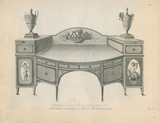
(Fig. 6) The design for a pedestal-end sideboard was first published in 1788.
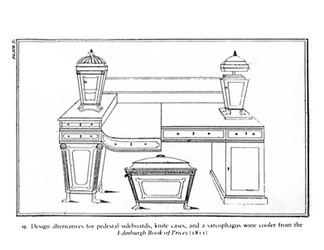
The pedestal-end sideboard became a popular, though expensive piece of furniture in New York during the first decades of the 19th century, and this was the form that George Clarke chose for his sideboard in 1813. It relates to the style of the British Regency period with the closest inspiration taken from a design in the Edinburgh Book of Prices (1811). An illustration from the book shows many shared features such as the canted corners of the pedestals, animal paw feet and a flattened elliptical center drawer that were incorporated into the Hyde Hall sideboard.
( Fig. 7) Edinburgh Book of Prices) Plate 7 of the Edinburgh Book of Prices is a likely source for specific designs found on the Hyde Hall sideboard.
There were a number of immigrant Scottish cabinetmakers in New York City at the time, the most famous being Duncan Phyfe. So it is very likely that a copy of the Edinburgh price book was available to Meads, who had trained in the City between 1792 and 1801 before moving to Albany. In fact, the quality of the design, construction and carving of the sideboard is so high and its similarity to several other sideboards attributed to New York City is so close that the Hyde Hall sideboard may be the work of a New York City cabinetmaker that was retailed by Meads to Clarke.
(Fig. 8) Clarke purchased a porcelain dining and dessert service attributed to the Parisian factory of Marc Schoelcher from Baldwin Gardiner’s “Furnishing Warehouse” in 1833. Part of it is set on the sideboard for a dessert course. Clarke acquired five separate dinner services between 1814 and 1833.
Hyde Hall’s pedestal-end sideboard has mahogany as a primary wood. The pedestals are framed by attached columns with Corinthian capitals located on canted corners and supported by finely carved hairy paw feet. Brass side rails incorporating a diamond motif are placed on the sides of the top, a rail design found on several other nearly identical sideboards from New York City. The solid mahogany backboard or “splash rail” is divided into three parts by mahogany plinths that support stylized carved pineapples, a traditional symbol of friendship and hospitality in the temperate climes of Europe and North America. The backboard is capped by a carved molding of acorns and oak leaves, an unusual detail on sideboards of the period, but it references earlier Clarke family history.
(Fig. 9) detail of oak leaf and acorn carving) The acorn and oak leaf carving on the backboard refers to historical family ties to Charles II.
George Clarke’s great grandmother, Anne Hyde (1693-1740), was a cousin of a branch of the Hyde family who were committed Royalists during the English Civil War. Three of them provided Charles II with crucial aid by giving him a safe place to stay for six nights, despite the possible penalty of “death without mercy,” during his perilous attempt to reach the safety of France after losing the Battle of Worcester in 1651. During his escape Charles successfully hid from the Parliamentary forces for a day in an oak tree. Upon his restoration to the throne in 1660, he rewarded those who had helped him and commemorated the oak tree event with Oak Apple or Royal Oak Day on May 29, his birthday, a holiday that is still celebrated in England. Family tradition holds that the acorn and oak leaf carving on the sideboard symbolizes the important role that the Hyde family played in saving the life of Charles II.
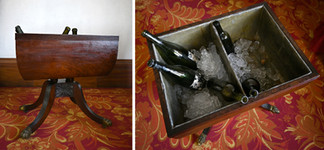
Just three months after completing the sideboard, Meads charged Clarke seventeen New York pounds or approximately $40 for a wine cooler. Wine in the early 19th century was relatively harsh, so it was almost inevitably cooled to palliate the taste. While not strictly en suite, the wine cooler has been kept in the central niche of the sideboard ever since. Wine coolers are relatively rare in American furniture, being more common in England. The Hyde Hall example has the rectangular body of the cooler resting on four small, flattened balls that are attached to a plinth supported by four concave and reeded legs. On the long sides of the plinth are inset rectangles with carved decorative clusters of eight leaves centered by a small cross-hatched oval. In 1822 Clarke paid for the construction of an ice house in the kitchen yard of Hyde Hall to store a year’s supply of ice from Otsego Lake for cooling his wine and other purposes.
( Fig. 10) The body of the wine cooler is lined with lead and divided into two compartments that were filled with ice to chill the wine bottles. A hole in the bottom allows melted ice to drain.
(Fig. 11 detail of brass pulls) The original lion head pulls on a “beaufett” or side table that Clarke purchased from Meads in 1813 are similar to the original pulls on the sideboard. Evidence on the inside of the drawer fronts of the sideboard shows that when Clarke purchased the sideboard in 1813, the handles were brass lion heads.
(Fig. 12 ring and rosette brasses) The brasses added in 1830 made the sideboard purchased in 1813 more up-to-date.
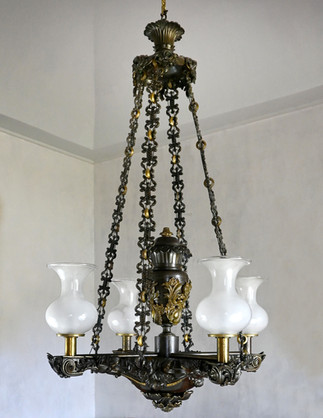
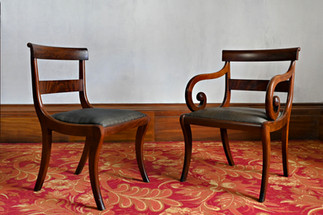
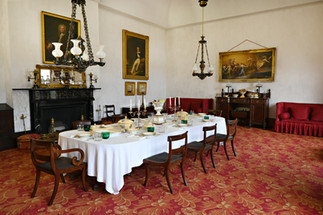
For his new dining room, a magnificent space measuring thirty-six by twenty-four feet with a cove ceiling eighteen feet high, he ordered a set of twenty-four chairs from Meads and his new partner William Alvord (1766-1853) in 1831, adding 12 more chairs in 1833. From Baldwin Gardiner he acquired a pair of English-made Argand chandeliers for $220. The chandeliers came with “hangings,” which allowed them to be lowered for cleaning, refueling and lighting, at a cost of $50. At the time of purchase, Clarke had the eight original Argand burners converted to vapor lights that used alcohol rather than whale oil at a cost of $2.00 each. In respect to his other furnishings in the room, Clarke installed the existing sideboard, wine cooler, dining table and side table holding extra table leaves that he had purchased in 1813, although he updated the sideboard by replacing the lion head brasses with ring and rosette brasses. The new handles may be part of Clarke’s purchase from Meads and Alvord of “8 Commode handles… 6 rings” on August 18, 1830.
(Fig. 13 Meads armchair and side chair) Clarke purchased a new set of six armchairs and eighteen side chairs in 1831 to seat twenty-four people at his dining table. Two armchairs and four side chairs from the set remain in the dining room today.
(Fig. 14 ) Hyde Hall’s new dining room required two chandeliers to help light the space. They and the single chandelier in the Hyde Hall drawing room are thought to be the only period vapor-light chandeliers that still function in their original location.
The sideboard and wine cooler are a tangible representation of Clarke’s sense of hospitality and they reflect both his culinary interests and his aesthetic taste for stylish mahogany furniture. In his Reminiscences published in 1852, Levi Beardsley (1785-1857), a lawyer, farmer and politician, gives an account of dining at Hyde Hall in which he recalls that Clarke “delighted to have his dinner got up in the old English style, with the best of roast beef and mutton, garnished with such delicacies as the lake and country afforded.”
Hyde Hall was renowned for fine dining for both guests and family, and Clarke was remembered as a sociable host noted for his singing and story telling. The contract for the construction of that part of Hyde Hall, which contained the new dining and drawing rooms, was signed on June 23, 1829. The same year Clarke began acquiring elegant accouterments for his table. He acquired a set of “Rich Cut” glassware that included “3 dozen Wines, 2 dozen Champaigns, 2 dozen Tumblers, 2 dozen Jelley Glasses on feet and 2 dozen Flint Green Flint Hocks.” In 1832 he purchased a second set of “Heavy Flute” glassware that included 36 tumblers, 36 green hock glasses, 24 wine glasses and 23 claret glasses. One of his most extravagent purchases was the 227-piece Schoelcher porcelain service at a cost of $500 from Baldwin Gardiner in New York City. In 1827 he had purchased an English stoneware dinner service of 129 pieces for $75.
Clarke’s interest in developing different aspects of New York agriculture was also reflected by the food served on the table. He promoted the development of specific breeds for better quality meat, and at Hyde Hall he raised herds of Midland Longhorn cattle, Leicester Longwool sheep, and Dishley pigs, while game came from the surrounding woodlands and fish from the lake. He created a large walled kitchen garden with an irrigation system that included a central fountain and gravel walks in 1820 and ordered an enormous variety of vegetable seeds each year to insure fresh produce throughout the growing season. An example of his culinary interests can be seen in his purchase of 400 asparagus plants in 1819 or twelve gooseberry bushes, six English walnut trees, six Spanish chestnut trees and six English filbert trees in 1828. In 1820, the first year he lived at Hyde Hall, he had six types of apple trees, five types of pear trees, seven types of plum trees, five types of cherry trees and twelve espaliered peaches planted in his garden. He continued to add more varieties of fruit trees on subsequent years writing that these were “for family enjoyment as well as for the purposes of hospitality.” Bills from grocers in Albany, New York City and Cooperstown record purchases of chocolate, bottles of guava jelly, mushroom catsup, anchovies, fresh oranges, candied ginger from Canton, oysters, bands of dates and boxes of almonds. For his three-room wine cellar, which includes twelve brick and stone bins with space for over 1500 bottles, he purchased cases of Champaign, Hock, Madeira, Medoc, Port, Sauterne and Reisling as well as barrels of ale, porter and rum. In 1830 he ordered six boxes of Chateau Margaux, Thomas Jefferson’s favorite wine, at the cost of $412.50. Both the sideboard and the wine cooler played essential parts in the conviviality of Clarke’s dining room.
(Fig. 15) As planned by Clarke, the lighting in the dining room was a pair of vapor-light chandeliers, Argand lamps on the mantel and sideboard and candles on the table. Through all the generations of Clarkes that lived at Hyde Hall, the family never introduced electricity to the room.
Reprinted courtesy of the Walpole Society