top of page


Planning for the future
Learn about our ongoing and future renovations.


The 1970s to present
Hyde Hall presents an opportunity to seize upon an untouched example of Anglo-American architecture and interpret it for people who appreciate and understand authenticity. The rich, detailed, and extremely rare context that survived in the form of its decorative elements is an extraordinary document of early American country house life.


Tin Top
This structure originally stood on East Lake Road, north of the current entrance to Glimmerglass State Park. It was the gatehouse to the Clarke estate, and various employees lived in the building throughout its history.


The Home Farm
The Home Farm is situated on Mill Road roughly a half mile north of the Caretaker's Cottage. This tenant farm supplied most vegetables for the Clarkes, along with additional barns and acreage for various livestock.


The Caretaker's Cottage
Over many generations, the estate caretaker and his family lived here, sometimes with other servants. The last two generations of Clarkes resided in the Cottage.
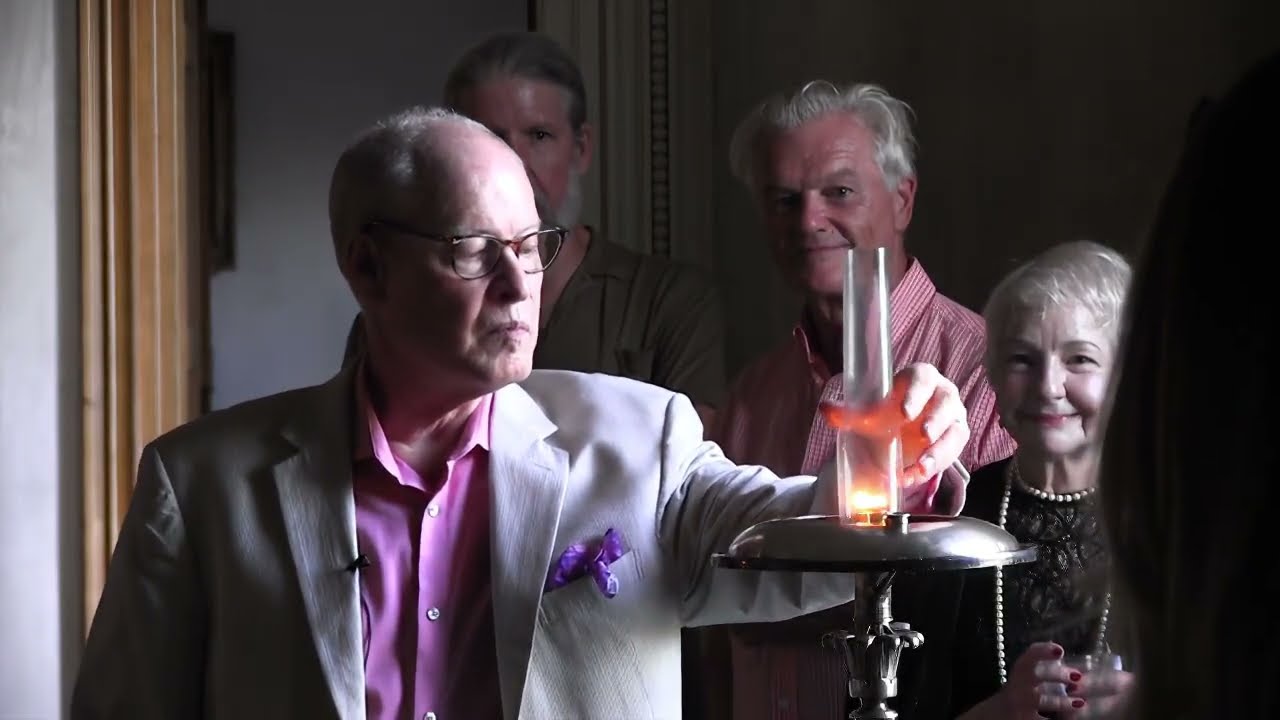
Let there be light
Learn about vapor light chandeliers and other ways the Clarkes illuminated Hyde Hall.


The Ellen Emmet Rand Collection
Rand was a frequent visitor to Hyde Hall. It was here that she created several works of art depicting Clarke family members and their close family friends.


Tablescapes
Ceramics and porcelains like those found in Hyde Hall were not only a symbol of prestige but also the byproduct of revolution and civil unrest in the late 18th and early 19th century.


The Stove Collection
When completed in 1834 Hyde Hall had eleven chimneys and four distinct types of heat, from the traditional open fireplace to a central heating system using a hot air furnace. The most numerous components of the systems used to heat the Hall were cast-iron stoves.


Sideboard
In a house full of treasures, this mahogany sideboard is a standout. It was the most expensive piece the Clarkes ever commissioned from John Meads, Albany’s leading cabinet maker.


Commode
A commode, from the French word for "convenient," was a functional piece of furniture before indoor plumbing.


Apothecary Chest
Modern medicine has come a long way over the past century, as evident with this 19th century Apothecary Chest. Also referred to as a Dispensatory or Medicine Box/Cabinet, this item would have been the Clarke family’s First Aid kit.


Brass Barreled Smoothbore Dueling Pistol
Pistols like this one were a common choice for duels, as short-barreled flintlocks were difficult to aim and had limited accuracy. This reduced the possibility of death in duels to as low as seven percent and added an element of chance that leveled the playing field.


Shepherd and Boyd Silver Ice Bucket
George Clarke "The Builder" owned several ice buckets engraved with the Hyde phaeton crest and reflect Clarke’s tastes stemming from a childhood England.


Original Stone House (1818-1821)
This wing of Hyde Hall, also known as the Stone Cottage, as always served as the family's living area.


West Wing (1820-1829)
Hyde Hall was built to impress. As it was an English custom to show off the entire house to guests, the service areas were attended to with meticulous detail.


The Great House (1829-1834)
The Great House wing—intended for formal entertaining—asserts itself as the architectural and social heart of the complex.


The Courtyard
The courtyard is a simple, orderly space shaped by the house itself. Enclosed on three sides by the stone walls of the Great House and its wings, it feels solid and intentional, like an outdoor room rather than a garden. The surfaces are plain and restrained. The ground is level and uncluttered, guiding visitors naturally toward the entrances. Windows facing the courtyard are modest, keeping the focus on the building’s mass and proportions. This courtyard acts as a transition
bottom of page